

The “Magic” of Tongues 3

Jesus’ disciples were gathered in an upstairs room.
Some sat motionless. Others fidgeted. Jesus had told them something was coming from God. He called it the Promise of the Father. He didn’t explain what it would look like or how it would arrive. He only told them to stay and wait.
They had no imagination for what was coming. No category. No idea this moment would later be described as speaking in tongues, or that it would shape how people prayed, spoke, and listened to God.
Outside, the city was loud with celebration. Inside, the room felt electric and still at the same time.
Then the heavens split and the earth shook.
The Spirit didn’t come with a tap on the door or a still voice calling their names. He didn’t rise slowly or give warning. He rushed in, loud and overwhelming, a whirlwind of fire and power.
Before anyone could stand or speak, the fire separated. It engulfed each person. Its heat erupting with vocal expression.
Their reaction was not planned. It was not practised. It was not understood. But it was alive.
This is where the Spirit of language entered the human story. Not as a teaching. Not as a rule. As an encounter.
When Fire Began to Speak
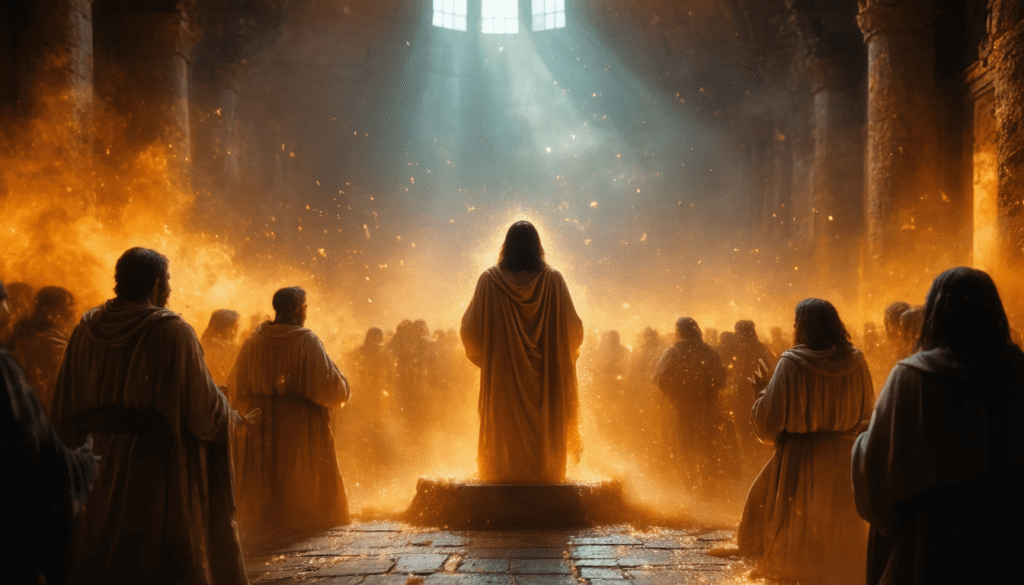
Suddenly, magic happened! Words, jubilant praise, and love ignited the atmosphere.
Pause a moment and let your heart and imagination envelope this scripture. What do you think it would have been like to be in that room?
Suddenly they heard the sound of a violent blast of wind rushing into the house from out of the heavenly realm. The roar of the wind was so overpowering it was all anyone could bear! Then a pillar of fire appeared before their eyes. It separated into tongues of fire that engulfed every one of them. They were all filled and equipped with the Holy Spirit and were inspired to speak in tongues – empowered by the Spirit to speak in languages they had never learned.
(Acts 2:2–4, TPT)
They were ON FIRE!
They Were Changed Forever
Nothing about this moment was quiet or symbolic. It was physical. Audible. Visible. Overwhelming.
Wind rushed in without asking permission. Fire did not hover politely at a distance. It engulfed them. Language followed. Not rehearsed speech. Not studied dialects. Something else entirely. A language born in God’s presence, released through human voices.
Fire spoke.
This is important. Fire did not only appear. It had expression. What arrived was not only power, but communication. Not simply noise, but language.
From the beginning, God has always moved through words.
“In the beginning, God created…” is not followed by an action, but by speech. God said, and creation responded. Light came. Order formed. Life emerged. The universe was spoken into being through the Voice, by the Word, through Christ.
This tells us something essential. Language is not fanciful speech. It is not an afterthought. It is a creative force.
And now, in the upstairs room, the same Spirit who hovered over the waters of creation lived within human beings. The breath shaping worlds moved through lungs. The fire speaking galaxies into place spoke through people.
Tongues were not random sounds. They were Spirit-language. Creative language. God’s creative breath moving again through words.
Why Language Still Carries Creative Power

This is where desire begins to stir, not because anyone is pressured, but because something beautiful is revealed.
If Jesus created through words, and if the Spirit who carried those words now lives and moves within the believer, then The Word has not lost its power. It has found a new dwelling place.
Remember, speaking in tongues is not about volume or display. They are about participation.
They allow human beings to cooperate with God’s creative movement without needing to understand everything first. They bypass control. They bypass performance. They move through trust.
This is why love matters so deeply here.
Paul makes it clear, language without love becomes noise. Sound without substance. But when language is activated by love, it builds. It restores. It gives life.
(1 Corinthians 13, NIV)
Tongues moved by love do not dominate. They do not manipulate. They do not seek attention. They participate quietly, or loudly, and powerfully in what God is doing.
This is why tongues are a gift we should desire. Not because they prove anything, but when they are connected to love they create. They return speech to its original purpose: giving life.
Fire Has Not Disappeared
The fire that fell in the upper room did not burn out when the moment passed. It did not belong to history. It did not retreat once the story had been written.
Fire has a way of travelling.
The same Spirit continues to move. The same breath continues to speak. The same creative language remains available to those willing to receive it.
This does not mean everyone will experience tongues in the same way. It does not mean everyone will experience them immediately. It does not mean everyone will experience them publicly. God is gentle. He works with people, not systems.
But the invitation remains open.
Tongues still offer a way to pray when ordinary words fall short. A way to speak to God when your mind doesn’t know what to say.
Fire still speaks.
Frequently Asked Questions
Was Pentecost a one-time event?
Pentecost was not a single event meant to stay in history. It marked the moment the Holy Spirit began dwelling with and within people in a new, ongoing way.
Pentecost began with the Holy Spirit arriving publicly and unmistakably, but it did not end when the sound faded or the fire disappeared. What changed in that upstairs room was not only the people present, but the way the Holy Spirit chose to relate to humanity going forward.
Before Pentecost, the Spirit came upon individuals for specific moments or purposes. After Pentecost, the Holy Spirit remained. He stayed close. He filled ordinary people and continued to guide, speak, and move through them in daily life. The book of Acts shows this pattern unfolding again and again, not as repetition, but as continuation.
For someone new to faith, it can help to think of Pentecost as the beginning of a relationship rather than a dramatic performance. The Holy Spirit did not arrive to impress. He arrived to stay with you. He entered human lives in a way that did not depend on location, culture, or time.
Pentecost shows the Holy Spirit no longer visits briefly and leaves. He dwells, walks, and works with people wherever they are.
Why did the Holy Spirit arrive with wind and fire?
The Holy Spirit used wind and fire because they communicate movement, life, and closeness in ways people recognise before they understand.
When the Holy Spirit entered the room at Pentecost, He did not begin with explanation. He began with experience. Wind and fire are not symbols chosen to be decoded. They are realities people feel in their bodies. They interrupt. They announce God’s presence.
Wind moves through space and breath. It cannot be controlled or contained. Fire brings light and heat. It draws attention. Together, they communicate something living has arrived. The Holy Spirit did not want to be mistaken for an idea or an emotion. He arrived in a way people could not ignore.
For first-time readers, these elements may sound dramatic. They were meant to be. The Holy Spirit was not distant or hidden. He came close enough to be felt, heard, and seen. Wind moved through the room. Fire rested on each person.
Importantly, the fire did not harm. The wind did not scatter. The Holy Spirit revealed power without destruction. Change happened without loss. He transforms you without damaging you. He moves without overwhelming those who remain open to Him.
Do tongues still matter today?
Tongues still matter because the Holy Spirit continues to use language as a way to move, pray, and communicate beyond human planning or control.
Tongues entered the Pentecost story as a response to Jesus’ promise. When the Holy Spirit filled the room, language followed naturally. The disciples did not decide to speak. Speech emerged because the reality of the Holy Spirit’s presence within them had been set in motion.
The Holy Spirit still works this way. Tongues is how He helps you speak to God when ordinary words fail you. They do not replace prayer or thinking. They extend them. They allow communication between you and God to continue while your understanding is still catching up.
Praying in tongues remove pressure. There is no need to choose words carefully or perform well. The Holy Spirit carries the movement. Your voice follows His presence rather than effort. This can feel freeing, especially when you struggle to express emotion, prayer, or longing.
Praying in tongues also teaches faith and trust. It asks for openness rather than control. The Holy Spirit does not use tongues to elevate some people above others. He uses them to draw people deeper into cooperation with Him. Language becomes shared work rather than individual achievement.
Tongues are valuable because relationship with God is precious. They are one way the Holy Spirit keeps communication flowing when needs move faster than vocabulary.
What if the Holy Spirit feels overwhelming or unfamiliar?
Feeling unsure or overwhelmed is common when encountering the Holy Spirit in new ways. He does not force experiences and does not rush people beyond trust.
Pentecost began with people who did not know what to expect. The Holy Spirit arrived suddenly, but He did not abandon those He interrupted. He remained present and steady as the moment unfolded.
The Holy Spirit often moves before people feel prepared. That does not mean something has gone wrong. It means encounter has arrived before understanding. Overwhelm frequently signals unfamiliar territory rather than danger.
For someone new to Christianity, spiritual experiences can feel unsettling at first. Sound, emotion, or physical awareness may surface unexpectedly. The Holy Spirit does not demand immediate clarity or confidence. He responds to your openness.
Importantly, the Holy Spirit respects pace. He stays near. He waits. He does not pressure people into response or comparison. Many discover tongues and other expressions of the Spirit slowly, over time, often in quiet moments rather than dramatic settings.
Pentecost teaches that encounter comes first, and understanding grows later. The Holy Spirit walks with people through this process patiently, never leaving them alone inside the experience.
Closing Reflection
If you have never been engulfed by the speaking fire of the Holy Spirit, you are not left behind. You are invited to join in.
The Holy Spirit does not rush, neither does He force people to speak in tongues. He leads gently and confidently.
Tongues remain one of the ways God invites you back into creative, living language. A way to speak when words have not yet formed.
The Promise did not end in that upstairs room.
The fire has not gone out.
It still speaks.
Tongues are not a test you pass. They are a gift you receive. And like every gift from the Holy Spirit, they arrive through love, not effort.
Stay. Listen. Let God come close in the way He chooses.
May your life be set on fire! 🔥🔥🔥
If this lit a spark in you, share the flame with another.
If you felt the hush of recognition, share it with a friend and widen the circle.
To keep the flame going, please buy me a candle 🙏🏻
Every story longs for another listener. Share it with the one who is waiting
Let’s stay connected and journey through the kingdom together! 🌸

Through God Enchantment, I write about the places where faith meets wonder and Scripture becomes alive in the everyday. Each reflection is an invitation to move beyond duty into delight, beyond religion into relationship, and to see the nearness of Christ in ordinary life.


I get so excited when I read this. Waiting for a breakthrough in speaking in tongues but have some type of blockage. But going for counciling
I also have blockage in speaking in tongues
Hi Judith
Please contact me on yvonne@godenchantment.com and I will help you.